Overview
TL;DR: The American Community Survey gives you free, annual demographic data on 40+ topics - but the tools for accessing it are so complex that most professionals never use it effectively.
- The ACS surveys 3.5 million addresses every year, covering income, housing, employment, education, and even internet access - at no cost to you
- Choosing between 1-year and 5-year estimates is not a minor technical detail; getting it wrong can make neighborhood-level analysis statistically meaningless
- The Census Bureau's own access tools are, ironically, one of the biggest barriers to using Census Bureau data
- Most professionals are paying for syndicated data that overlaps significantly with what the ACS already provides for free
- Natural language tools now let you query ACS data directly, collapsing a multi-step research workflow into a single plain-English question
There is a reasonable chance your company is paying for market research data that the U.S. government already collects, cleans, and publishes every year - for free. The American Community Survey covers household income, employment status, housing costs, commute times, health insurance coverage, educational attainment, and broadband internet access, across every county, census tract, and block group in the country. It is updated annually. It is publicly available. And for most marketing, research, and strategy teams, it is almost entirely untouched - not because the data is poor, but because the tools for accessing it were built for statisticians, not strategists.
That gap is worth closing. Here is what the ACS actually contains, where professionals consistently go wrong when using it, and how the access problem is finally being solved.
What the American Community Survey Actually Covers
Most professionals who have heard of the ACS assume it is primarily a population headcount - a more frequent version of the Decennial Census. That assumption undersells it considerably.
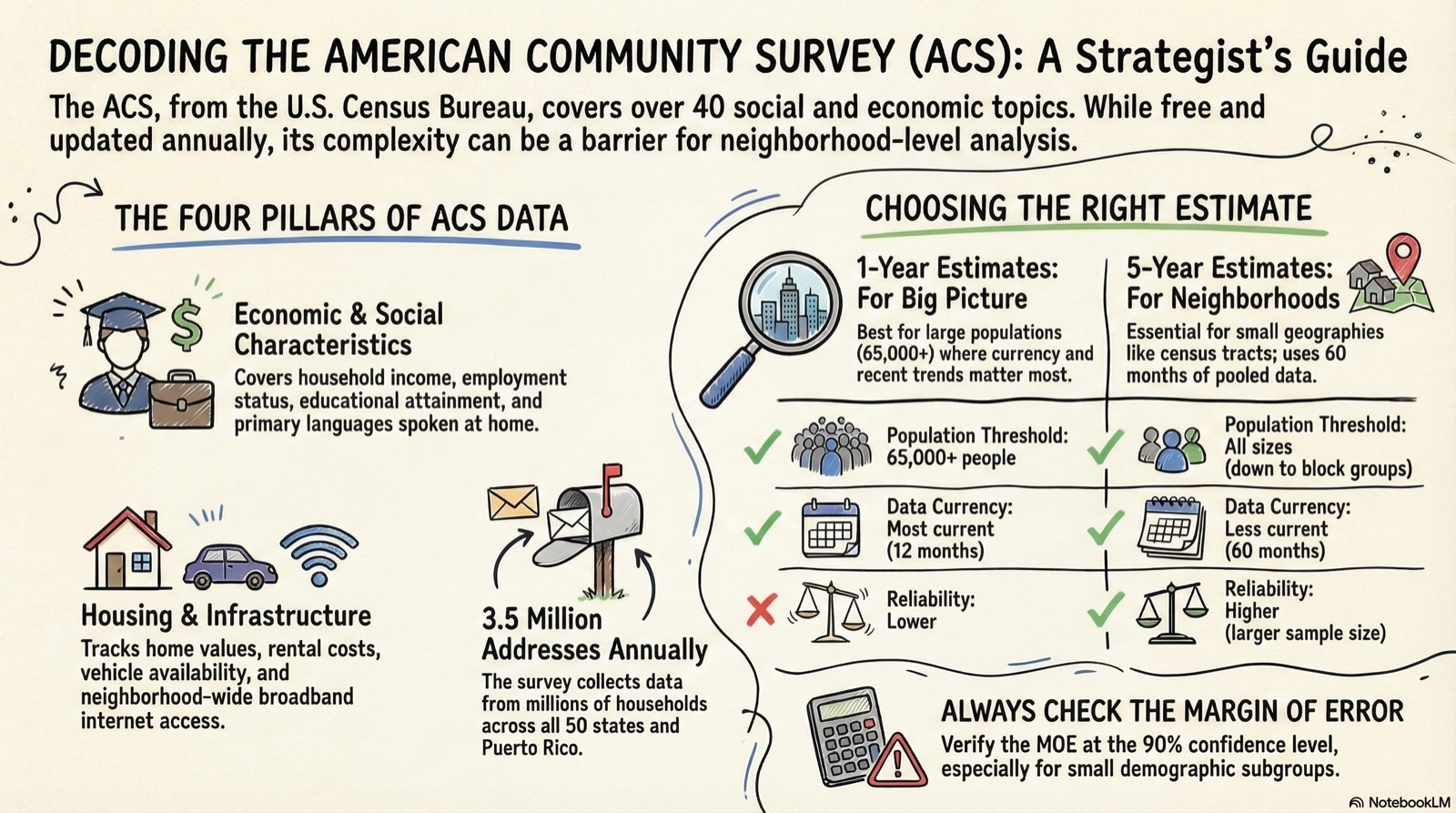
The ACS is conducted by the U.S. Census Bureau across approximately 3.5 million addresses every year, producing estimates across more than 40 topics. Those topics fall into four broad categories, each with direct professional applications:
- Social characteristics: Educational attainment, language spoken at home, disability status, veteran status, ancestry and place of birth. Useful for understanding the cultural and social composition of a community, identifying underserved populations, or scoping language accessibility needs.
- Economic characteristics: Household income and earnings, employment status, industry and occupation, poverty status, health insurance coverage. This is the category most relevant to market sizing, site selection, and economic development work.
- Housing characteristics: Whether residents own or rent, home values, monthly housing costs, vehicles available, year the structure was built, and computer and internet use. Particularly valuable for real estate analysis, infrastructure planning, and digital access research.
- Demographic characteristics: Age, sex, race, Hispanic or Latino origin, total population, relationship to householder. The foundational layer that underpins almost every other form of audience analysis.
The breadth here is the point. A retail strategist evaluating a new location can pull income data, renter rates, and vehicle availability together from a single source. A public health researcher can cross-reference poverty status with health insurance coverage. A policy team can map disability rates and limited English proficiency against service delivery gaps. The data infrastructure for all of this already exists.
The Estimate Type Decision Most Analysts Get Wrong
Before you pull a single ACS figure, there is one structural choice that will determine whether your analysis is valid: 1-year estimates or 5-year estimates. These are not interchangeable, and conflating them is a common and consequential error.
1-year estimates are based on 12 months of data collection. They are the most current figures available, but they come with a significant constraint: they are only published for geographic areas with populations of 65,000 or more. Smaller areas simply do not have large enough sample sizes to produce statistically reliable 1-year figures. If you are tracking national or state-level trends where currency matters most, 1-year estimates are the right choice.
5-year estimates are based on 60 months of pooled data. The larger sample size makes them far more statistically reliable, and critically, they are available for every geographic level - including census tracts and block groups. If your analysis involves any geography smaller than a mid-sized city, 5-year estimates are not optional; they are the only option that will produce defensible results.
A practical way to think about it: a policy analyst monitoring national poverty trends should reach for 1-year estimates. A marketer identifying the right neighborhood for a new physical location needs 5-year estimates to work at census tract resolution - typically covering between 1,200 and 8,000 people, granular enough to see real neighborhood-level variation.
One additional note: every ACS estimate comes with a Margin of Error reported at a 90% confidence level. For large geographies with big sample sizes, MOE is rarely a concern. For small geographies or small demographic subgroups, it can be significant enough to affect your conclusions. Checking MOE before citing a figure is not optional due diligence - it is basic analytical hygiene.
Why Most Professionals Never Actually Use It
The data is free, annual, and remarkably detailed. So why do so many professionals default to expensive syndicated research instead?
The honest answer is that the Census Bureau's primary access tool - data.census.gov - was built for people who already know what they are looking for. To retrieve median household income by county for a single state, you need to know that the relevant table is called B19013, apply the correct geographic filters, navigate the results interface, and then export the data for visualization in a separate program. That is a workable process for someone trained in Census data architecture. For a marketing director or a policy analyst working against a deadline, it is a genuine barrier.
The API alternative is more powerful but even more technically demanding, requiring familiarity with query parameters, variable codes, and data structures that have no intuitive entry point for non-technical users.
The result is a predictable pattern: professionals either pay for a data vendor to do the extraction work for them, or they simply skip the ACS entirely and rely on softer sources. Neither outcome makes much sense when the underlying data is this good.
How the Access Problem Is Being Solved
The shift happening now is not about making data.census.gov easier to navigate. It is about bypassing that complexity entirely through natural language interfaces that sit on top of the ACS and translate plain-English questions into structured data queries.
Instead of searching for table B19013, a user can ask: "Create a map of median household income by county for California." Instead of identifying the correct variable code for internet access, they can ask: "What percentage of households in Arizona counties have broadband access?" The query is interpreted, the correct ACS table and geographic filters are applied, and an interactive output is returned - in seconds rather than hours.
This changes the practical utility of ACS data considerably. The bottleneck was never the data itself; it was the distance between a strategic question and a usable answer. When that distance collapses, the ACS stops being a resource for specialists and starts functioning as a routine part of how teams do early-stage research.
Wrapping Up
The American Community Survey is not a niche government resource. It is one of the most comprehensive, current, and detailed sources of demographic and economic data available anywhere - and it costs nothing to access. The professionals getting the most value from it right now are not necessarily the most technically skilled; they are the ones who have stopped treating data access as a manual process and started asking questions directly.
If your team is currently paying for audience or demographic data, it is worth asking how much of it is already available in the ACS. And if the answer leads you toward questions like "what does this neighborhood actually look like economically?" or "which counties have the highest concentration of our target demographic?" - that is exactly the kind of question Cambium AI is built to answer. It pulls from public datasets, including the ACS, and lets you explore the data through plain-English questions without a data team or a subscription to anything beyond the platform itself.
The data has always been there. The question is whether your workflow lets you use it.
Further reading: Using the American Community Survey for Market Research