Key takeaways
- Check five things before using a persona, starting with a named data source others can open, such as the American Community Survey, and its sample size.
- Ask for the margin of error and geographic resolution: a national average does not describe one metro, and a metro figure does not describe one county.
- Check the date of the underlying data, and whether a colleague with the same source and question would arrive at roughly the same persona.
A persona is doing work the moment it lands in a campaign brief. It shapes the headline, the channel mix, the offer. By the time the campaign goes live, that persona has touched every line of the plan. That is a lot of weight for a short profile, and the honest question is whether it earned it.
Where most personas come from
Most personas in circulation today are produced in one of two ways. Some come out of a workshop, a few hours of post-its and group conversation. Others are generated by an AI tool from a job title and a short brief. The output reads well. It rarely tells a marketer where the underlying numbers come from.
The Research Live "Terms of engagement" series put it plainly: synthetic personas need verified supporting evidence to be safe to act on. That evidence is what verification is for.
Cambium AI was built so that a marketing team does not have to do the methodology work themselves. The underlying data sources, the sampling, the geographic resolution: that is the hard work Cambium AI takes on so the answer can be used rather than reconstructed. The five questions below are the ones a verified persona answers by construction. A workshop persona or an AI prompt usually cannot answer all of them.
Five questions to ask of any persona
Use these in order. If a persona cannot answer one of them, that is the verification finding.
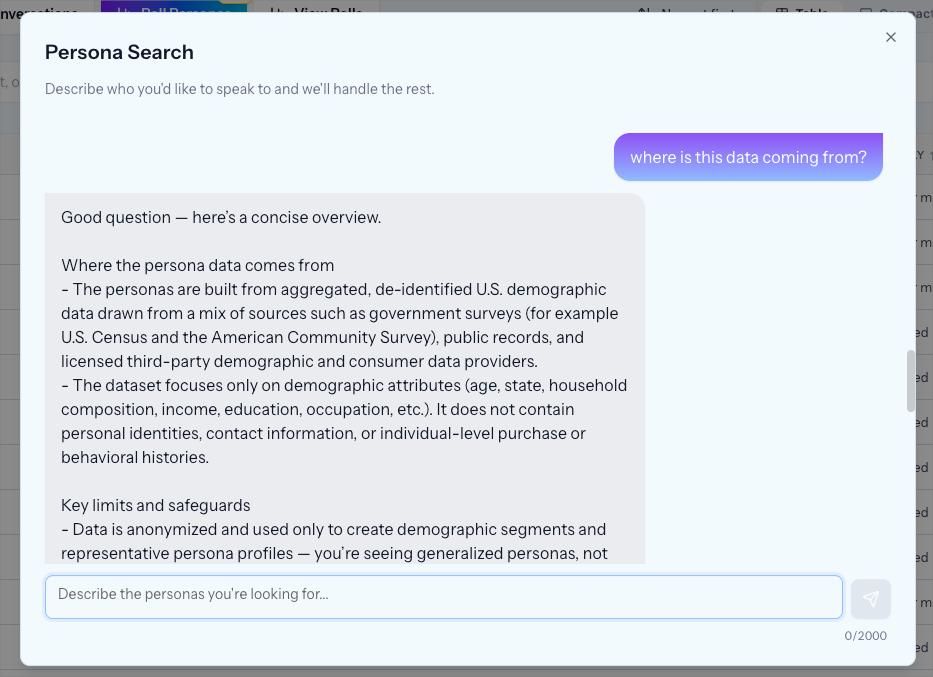
1. What data source sits behind this persona?
Name it. "An AI tool" is not a source. "Behavioural signals" is not a source. A source is a dataset that a second person can open. The American Community Survey, the U.S. Census Bureau's annual household survey, is a source. So is the Bureau of Labor Statistics' occupational employment data. So is a panel with a published methodology. Cambium AI is built on the first kind: verified public data, documented at the variable level. If a persona's underlying data cannot be named, the persona is a story, not a finding.
2. What sample, and how big?
Sample size sets how confidently the persona can claim anything. A panel of 400 respondents in one US city will not tell a marketer what is true nationally. Public data sits at the other end of that range: the survey draws on roughly 3 million addresses a year, with detail down to the local-area level. The Census Bureau publishes its design and methodology for anyone who wants to read it. A persona produced in Cambium AI inherits that sample without the marketer having to learn the documentation.
3. What is the margin of error, and at what geographic resolution?
Every estimate has a confidence interval, and the Census Bureau publishes a 90 percent margin of error against every estimate in the survey. Many AI-generated personas do not surface a margin of error at all. A 5 percent claim with a margin of plus or minus 8 percent is a different claim from one with a margin of plus or minus 1 percent. Geographic resolution matters in the same way: a national average will not tell a marketer what is true in one metro, and a metro number will not tell them what is true in one county. Open the app, and the persona is anchored to a specific population at a specific resolution rather than a stereotype.
4. When was this last refreshed?
Persona's age quietly. A profile written from 2019 panel data does not describe the same population in 2026. The survey refreshes annually; behavioural signals refresh in days; a workshop persona refreshes when someone notices it has gone stale, usually too late. A working persona should carry the date of the underlying data.
5. Can two people reconstruct the same answer from the same source?
This is the methodology test. If a colleague is given the same data source and the same question, they should arrive at a persona that looks roughly the same. If the output depends on the model, the prompt, or the analyst, the persona has not been derived from the data. In Cambium AI, the same population query returns the same answer for the next person in the team, because the data is doing the work rather than a prompt.
Putting the checklist to work
A marketing team is writing a campaign brief for first-time homebuyers in the Southeast. The persona on the desk says they are in their early thirties, earn around the national median, and rent in walkable neighbourhoods.
Run the checklist. Data source: silent. Sample size: silent. Margin of error: not stated. Refresh date: unclear. Reproducibility: untested.
The persona may still be roughly correct. The point is that no one in the room can tell. That is the moment to slow down and verify before the campaign budget moves.
What changes when a persona can answer the checklist
A verified persona behaves differently in the room. The marketer can defend it under pressure, and the campaign decisions sit on a foundation that does not move when someone asks a hard question.
This is the work Cambium AI exists to take off a marketing team's plate. The American Community Survey, the Decennial Census, the Bureau of Labor Statistics: each is open and documented, and each takes real time to query, join, and verify. Cambium AI has built that pipeline so a marketer can ask a question of the population and get a verified answer back. For the broader category, the primer on what public data is covers the sources on which Cambium AI is built on. None of this replaces qualitative work or direct conversations with customers. It is part of the picture that can be checked.
Verification is not a brake on speed. It is what makes the speed safe. Ready to see how Cambium AI can help build your audience personas? Book a demo here.