
Overview
TL;DR: Most audience definitions are too broad to be useful - here's a systematic approach to demographic segmentation that turns public data into precise, actionable marketing strategy.
- Demographic data is prescriptive, not just descriptive: it should shape your strategy before a campaign brief is written, not confirm assumptions after the fact
- Stopping at age and gender is one of the most common and costly segmentation mistakes marketers make
- Layering income, education, geography, and behavioral proxies reveals the high-value sub-segments hiding inside broad audience definitions
- Public demographic datasets are freely available, but most marketers never use them because the technical barrier feels too high
- Natural language AI tools have removed that barrier entirely, compressing weeks of research into a single afternoon
You already have a target audience. The problem is, it's probably too loose to be useful.
"Young professionals aged 25 to 40" tells you almost nothing about how to write an ad, which platform to buy media on, or whether your product solves a real problem for the people you're imagining. It feels like a strategy, but it's closer to a placeholder - a way to start moving without actually doing the hard work of understanding who you're talking to. And in a market where ad spend is scrutinized and every campaign has to justify itself before it launches, that kind of vague definition is genuinely expensive.
The good news is that the data to fix this is largely free, publicly available, and - increasingly - accessible to anyone who knows how to ask the right questions.
Why Most Audience Definitions Are Too Shallow
The instinct to define audiences broadly comes from a reasonable place. Narrowing too early feels risky. What if you exclude someone who would have converted? What if your hunch about the core segment turns out to be wrong?
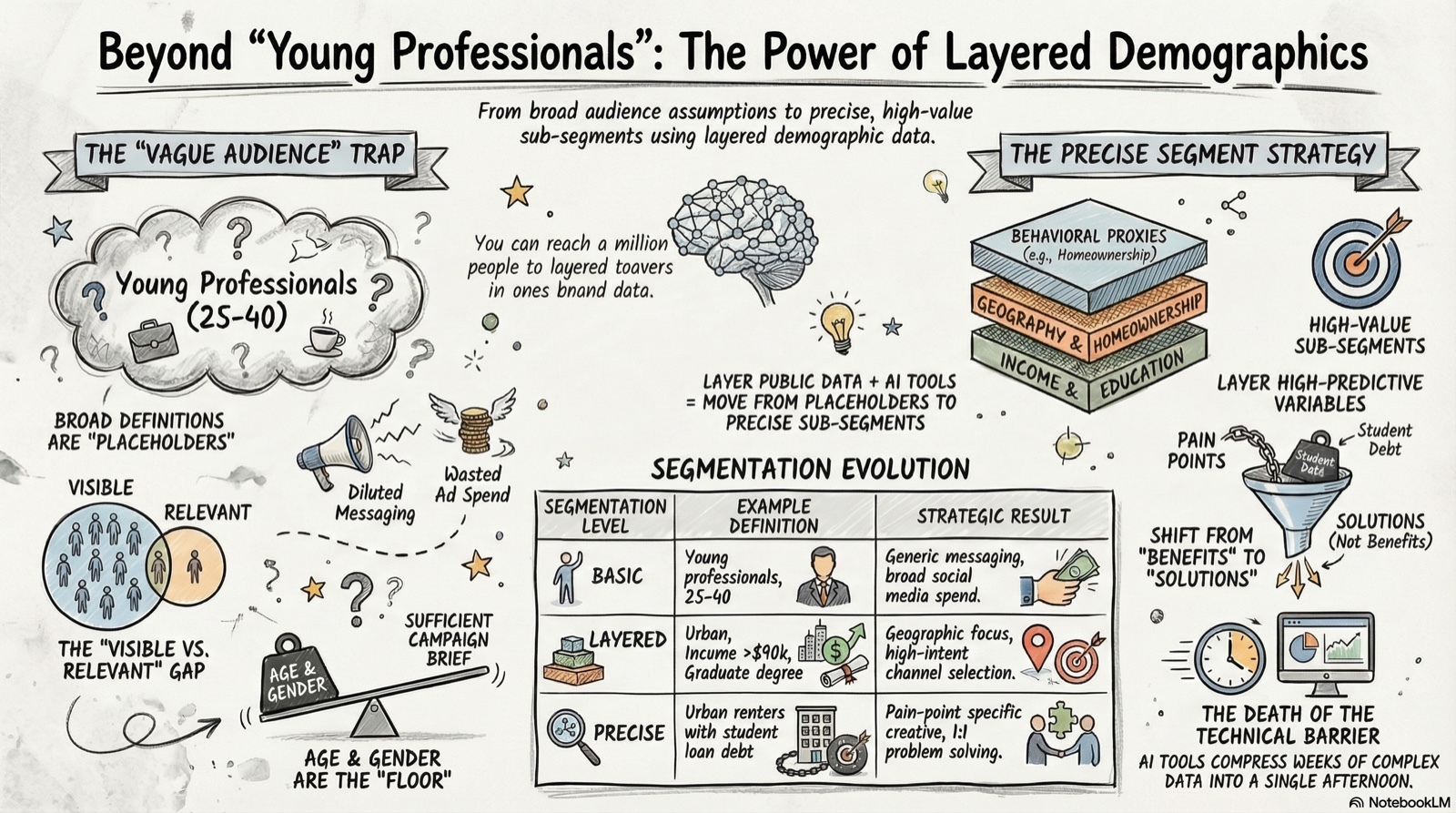
But the research consistently points the other way. Overly broad targeting dilutes messaging, drives up cost per acquisition, and produces campaigns that feel generic to everyone instead of relevant to anyone. The "visible vs. relevant" problem is real: you can reach a million people with the right demographic profile and still generate almost no response because nothing in your creative actually connects with their specific situation.
The fix isn't about targeting fewer people for the sake of it. It's about knowing enough about your highest-value segment to say something that actually lands.
Here's where most audience definitions stop - and where they should keep going:
- Age and gender - This is the floor, not the ceiling. Nearly every brief includes these. They're necessary but not sufficient.
- Income and education level - These two variables often do more predictive work than age. A 35-year-old with a graduate degree and a household income above $90,000 has fundamentally different purchasing behavior than a 35-year-old earning $40,000 in the same city.
- Geographic specificity - "Urban" is not a targeting parameter. Which cities? Which zip codes? Are you talking about walkable dense neighborhoods or sprawling suburban metros? These distinctions change your channel strategy, your creative tone, and your media mix.
- Behavioral and situational proxies - Student loan debt, homeownership status, presence of children in the household, commute time: none of these are exotic data points. They're all captured in public datasets, and they often predict purchase intent better than demographics alone.
The Startup Founder Mistake (And How Data Fixed It)
Consider a founder launching a financial planning app. Her initial assumption: the product has broad appeal to young professionals. Reasonable starting point. But when she actually queried demographic data rather than relying on that assumption, the picture got much sharper.
The segment that emerged wasn't "young professionals." It was young professionals in specific urban centers, earning above a certain income threshold, carrying existing student loan debt. That sub-segment had a clearly identifiable pain point the app could directly address. It also had a predictable media diet: personal finance podcasts, professional networking platforms, email newsletters from fintech publications.
Three things changed immediately:
1. The messaging shifted from generic financial planning benefits to student loan management and early-career investment strategy - language that spoke to a real, felt problem rather than an abstract goal 2. The channel mix narrowed to platforms where this demographic actually spent time, rather than broad social media buys 3. The geographic targeting concentrated ad spend in the zip codes where this population was most dense, reducing waste on irrelevant inventory
None of this required a data science team or a custom research study. It required asking better questions of data that was already publicly available.
The Demographic Variables Worth Layering
If you're building a segmentation model - even an informal one to guide a campaign brief - here are the variables that consistently do the most work when layered together:
- Age range (but tighter than you think - "30 to 35" is more useful than "25 to 45")
- Household income bracket
- Educational attainment
- Occupation category or industry
- Geographic location (metro area, then zip code level if possible)
- Housing tenure (owner vs. renter signals life stage and financial behavior)
- Household composition (presence of children, multigenerational households)
- Transportation access (relevant for physical retail, community programs, and service businesses)
- Device behavior (mobile-first users require different creative formats and landing page experiences than desktop users)
The U.S. Census Bureau, American Community Survey, and related federal datasets contain most of this information at the zip code level - for free. The barrier has never been availability. It's been the technical complexity of extracting and cross-referencing it without a data background.
Why the Technical Barrier Has Been the Real Problem
Ask any generalist marketer whether they've ever built a campaign using Census Bureau data, and most will say no. Not because they didn't want to. Because pulling meaningful cross-tabulations from large government datasets without SQL skills or data visualization experience is genuinely hard - hard enough that most people decide the insight isn't worth the time cost and proceed on assumption instead.
This is where the shift in AI tooling matters. Natural language querying over public datasets means you can ask a question like "Show me zip codes in California with median household income above $80,000 and a population over 50,000" and get a usable answer in seconds. No data wrangling. No pivot tables. No waiting for an analyst to come back with results next Thursday.
That capability changes the economics of demographic research. When the time cost drops from three weeks to twenty minutes, it becomes viable to run demographic validation as a standard step before any campaign brief is finalized - not as a luxury for big-budget research projects.
This Applies Beyond Commercial Marketing
It's worth noting that this framework isn't only relevant for product marketers and paid media teams. Public health communicators, nonprofit program designers, and policy professionals face exactly the same segmentation challenge.
A community health initiative targeting families with young children in areas with limited public transportation has almost nothing in common strategically with an initiative targeting seniors in dense, walkable urban neighborhoods - even if both groups are nominally within the same income bracket. Age distribution, transit access, and household composition all shape what outreach channel, what message, and what program format will actually reach people. The demographic data to make those distinctions exists. The question is whether your team knows how to access it.
Wrapping Up
The gap between "broad audience definition" and "hyper-targeted campaign" is usually not a strategy problem. It's a data access problem. Most marketers know they should go deeper. The obstacle has been the cost - in time, technical skill, and research budget - of doing so systematically.
That obstacle is smaller than it used to be. Public demographic data covers most of the variables that drive campaign performance. The frameworks for applying it are straightforward. And the tools to query it without a data science background now exist.
The next time a campaign brief lands on your desk with "young professionals" as the target audience, push on it. Ask which cities. Ask what income range. Ask whether they rent or own. Ask what debt obligations they're managing. Each of those questions has an answer in public data - and each answer makes the campaign sharper.
That's exactly the kind of question Cambium AI is built to answer. It lets you explore demographic segments across U.S. public data using plain English, generate representative personas from real population data, and stress-test your audience assumptions before you commit budget to a campaign. If you're doing early market research or trying to turn a vague audience brief into something precise, it's worth exploring.
Further reading: Leveraging Demographic Data for Hyper-Targeted Marketing


.png)