Key takeaways
- The 2019-2023 American Community Survey puts New York County (Manhattan) at 1,627,788 residents, with a median household income of $104,553 and per capita income of $94,922.
- Manhattan's civilian labor force is 950,067, with 66,581 people actively seeking work, while 471,216 residents aged 16 and over are not in the workforce.
- Of New York County's 918,806 housing units, 566 are mobile homes, while 308,005 renter-occupied units sit in buildings with 50 or more apartments.
At the very core of America’s most iconic city lies New York County, better known to the world as Manhattan. Home to 1,627,788 residents (2019-2023 ACS), this celebrated borough is a microcosm of the United States itself, brimming with diversity, energy, and opportunity. For anyone curious about how world-class urban living, historic neighborhoods, and global culture intersect, New York County stands as a remarkable example.
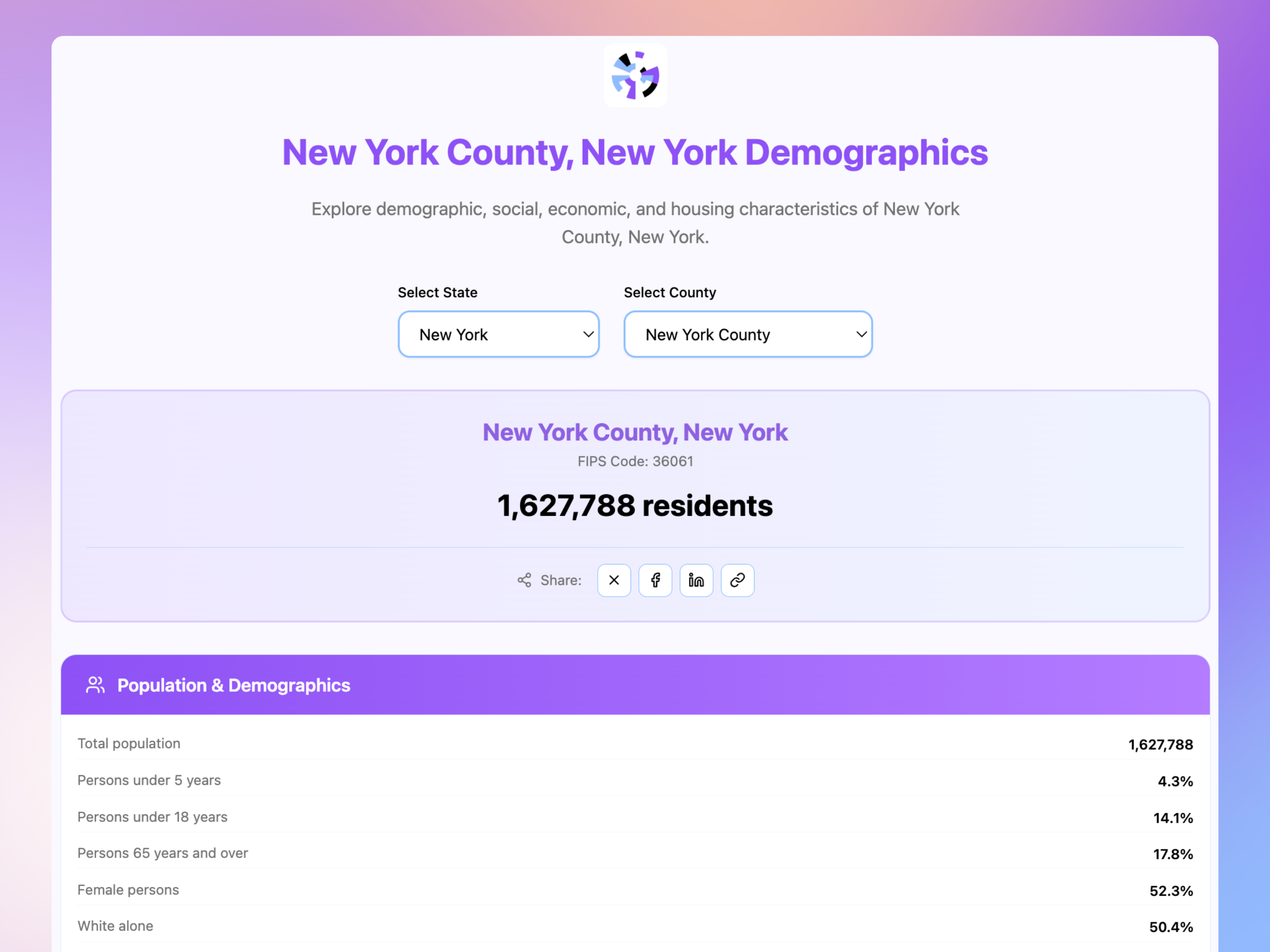
A Snapshot of the Community
Census data shows that with over 1.6 million residents, New York County is among the most densely populated places in the country. Here, people from around the globe live side by side in neighborhoods that combine the old with the very new, from Upper West Side brownstones to the shimmering glass towers of Hudson Yards.
Demographics and Age
Manhattan harbors both youth and experience. Among its significant senior population, there are 14,209 men and 25,342 women ages 85 or older. Whether students, working professionals, or retirees, people from all walks of life find a place in these famous city blocks.
Diversity and Heritage
New York County’s identity is rooted in diversity. Out of its total population, 196,082 residents identify as “Some Other Race Alone,” while 106,992 people identify with “Two Races Including Some Other Race.” Another 66,355 report “Two Races Excluding Some Other Race, and Three or More Races.” These statistics highlight the borough’s long reputation as a melting pot, welcoming millions whose traditions shape every corner — from Harlem’s jazz legacy to Chinatown’s bustling markets and Washington Heights’ Dominican rhythms.
Economic Landscape
Income
It’s no surprise that Manhattan leads much of the nation in household prosperity. The median household income reaches $104,553, and the per capita income stands at $94,922 — enviable benchmarks. Still, this prosperity also comes with a high cost of living that can challenge newcomers and longtime residents alike.

Employment
With a resident labor force of 950,372, Manhattan’s economic engine powers not only itself, but much of New York City as a whole. The civilian labor force is slightly lower at 950,067, with 66,581 actively seeking employment. Meanwhile, 471,216 county residents aged 16 and over are not in the workforce, comprising students, retirees, and others who are outside the job market.
Manhattan has legendary status as a financial, media, cultural, and tech hub. From Wall Street’s traders to hospital workers, artists, and gig economy professionals, the borough’s diversity extends through every facet of its employment base.
Housing and Living Environment
Housing Stock
New York County’s built environment is famous worldwide, and the numbers bear out its diversity:
- 918,806 total housing units reflect the borough’s extensive residential reach.
- 11,828 renter-occupied units are in small buildings with 3 or 4 apartments.
- Mobile homes are rare, with just 566 units in a sea of high-rises and brownstones.
- A staggering 308,005 renter-occupied units are in buildings with 50 or more apartments — evidence of Manhattan’s vertical, densely packed housing stock.
This variety, from sky-high luxury towers to historic brick walkups, underlines the borough’s capacity for change and inclusivity.
Quality of Life
While life here means adapting to rapid movement, crowded streets, and high expenses, it also offers unrivaled access to arts, public parks, public transit, and education — all set against the glass and steel of an ever-changing skyline. For many, the energy and resources available in every neighborhood prove irresistible.
Education
Despite the county’s cosmopolitan reputation, educational attainment still reflects a range of opportunity and need:
- 27,197 adults report a highest education level of kindergarten or less — a tiny fraction, yet a reminder of persistent gaps.
- 37,678 have achieved no higher than fourth grade.
- 72,130 have an education level no higher than eighth grade.
- 15,095 finished eleventh grade, short of completing high school.
While the majority of Manhattan’s workforce holds college and postgraduate degrees, these figures speak to the variety of backgrounds present and the enduring mission to lift everyone toward greater opportunity.
Community and Culture
New York County pulses with cultural life. From Broadway’s lights to art galleries, major libraries, world-class museums, and festivals for every group and tradition, this area’s cultural offering knows no equal. Annual parades, neighborhood street fairs, and community events ensure that every resident finds a place to belong. Even in an urban area famous for hustle and anonymity, a robust network of neighborhoods, religious and cultural centers, and outreach organizations fosters community bonds.
From Little Italy’s feasts to East Harlem’s heritage and the world’s food scene on every corner, Manhattan’s daily culture is visible, audible, and delicious.
Recreation and Natural Beauty
Central Park’s 843 acres are just the beginning — the borough features miles of waterfront paths, small parks, green rooftops, and historic squares. Residents enjoy farmer’s markets, cycling, river cruises, and community gardens, demonstrating that nature and recreation flourish even in the nation’s largest city.
Challenges and Opportunities
New York County’s advantages are balanced by serious challenges: sky-high housing costs, stark income inequality, and the ever-present risk of being priced out. Despite prosperity, persistent educational and employment gaps remain, and household budgets are stretched by rent, transportation, and childcare. Yet, the borough’s long record of innovation, activism, and resilience suggests that new solutions and support systems are part of Manhattan’s DNA.
Conclusion: Looking Ahead
To live or even visit New York County is to take part in a story that spans continents, centuries, and generations. With its diverse people, world-class culture, and constant reinvention, Manhattan remains a symbol of American aspiration. While the pace may be dizzying and the stakes high, the opportunities are vast, and the community’s sense of belonging and pride is unshakable.
All census figures in this post come from the 2019-2023 American Community Survey (ACS) 5-year estimates, providing a statistical snapshot of New York County life
Find more data about New York County using Cambium AI for free here.

.png)