
Pricing decisions shape revenue, market access, and long-term sustainability. Yet willingness to pay remains one of the least rigorously tested inputs in pricing strategy. Many organizations rely on surveys, competitor benchmarks, or internal consensus without fully validating whether proposed prices align with customers’ actual economic reality.
Willingness to pay is not an abstract preference. It is constrained by income, cost of living, spending priorities, and perceived alternatives. Testing it accurately requires more than asking hypothetical questions. It requires connecting pricing research to verified income data and evaluating how different customer segments behave under realistic financial constraints.
Synthetic personas provide a practical way to bridge this gap. When grounded in real demographic and income distributions, they allow teams to simulate pricing responses across diverse segments before committing to market changes.
What Willingness to Pay Measures and Why It Is Often Misinterpreted
Willingness to pay refers to the maximum amount a buyer is prepared to spend for a product or service under specific conditions. In economic terms, it represents the point at which perceived value equals price. This concept is widely used in pricing strategy, demand modeling, and welfare economics
Despite its importance, willingness to pay is frequently mismeasured. Direct survey questions tend to overestimate real purchasing behavior. Research consistently shows that respondents inflate stated willingness when no real trade-off or consequence is present.
This gap between stated intent and actual behavior is one reason many pricing decisions fail after launch.
Common Approaches to Pricing Research and Their Limits
Most pricing research follows one or more of these patterns:
-
Benchmarking against competitors’ published prices
-
Surveying customers about acceptable price ranges
-
Running small pilots without segmentation
-
Relying on historical pricing precedent
Each method has value, but none is sufficient on its own.
Competitive benchmarking ignores differences in audience composition, geographic distribution, and product positioning. Surveys often fail to account for respondents’ income constraints or spending trade-offs. Small pilots may not capture variability across segments. Historical pricing may reflect legacy decisions rather than current market conditions.
The core limitation across these approaches is the lack of economic grounding. Prices are evaluated in isolation rather than in the context of what different groups can realistically afford.
Why Income Data Matters for Pricing Strategy
Income sets the upper boundary for willingness to pay. Even when a product delivers strong value, customers cannot consistently purchase beyond their discretionary spending capacity.
Public income data provides a way to anchor pricing research in reality. In the United States, the American Community Survey offers detailed, regularly updated data on household income, earnings, education, and employment at national, state, and local levels.
Comparable datasets exist in many other countries through national statistical agencies.
Using income distribution data allows pricing teams to:
-
Identify realistic spending ceilings for target segments
-
Understand regional variation in purchasing power
-
Avoid designing prices that systematically exclude large portions of the market
Income data does not dictate pricing, but it establishes constraints that pricing decisions must respect.
The Role of Segmentation in Willingness to Pay
Willingness to pay varies across segments defined by income, geography, usage intensity, and needs. Treating the market as a single group leads to average pricing that fits few customers well.
Effective segmentation typically combines:
-
Demographics such as age and household income
-
Geography and cost-of-living differences
-
Behavioral signals such as usage frequency or problem severity
-
Psychographic factors such as priorities and risk tolerance
Segmentation provides the structure needed to evaluate how willingness to pay differs across groups, rather than assuming a single optimal price.
Established Methods for Measuring Willingness to Pay
Several pricing research techniques are commonly used to estimate willingness to pay:
Price Sensitivity Meter (Van Westendorp)
This approach asks respondents to identify prices they consider too cheap, cheap, expensive, and too expensive. It helps define acceptable price ranges but relies on self-reported perceptions.
Conjoint and Choice-Based Analysis
These methods infer value by observing how respondents trade off features and price in simulated choices. They are more robust than direct questions but require careful design and sufficient sample sizes.
Incentive-Compatible Experiments
Techniques such as the Becker–DeGroot–Marschak method encourage truthful responses by linking stated willingness to real outcomes.
Each method captures part of the picture. None fully resolves the gap between stated willingness and real economic constraints on its own.
Where Synthetic Personas Add Value
Synthetic personas address a key limitation in traditional pricing research. They enable teams to simulate how different customer types behave when pricing decisions interact with income, preferences, and constraints.
Unlike fictional personas, synthetic personas are built from real demographic distributions, income data, and behavioral patterns. They represent statistically plausible customer profiles rather than idealized archetypes.
When applied to pricing, synthetic personas allow teams to:
-
Model willingness to pay across income brackets
-
Explore price sensitivity by segment before market exposure
-
Test tiered pricing and packaging strategies
-
Identify segments likely to convert or churn at specific price points
This shifts pricing analysis from static averages to dynamic, segment-level behavior.
.gif?width=1920&height=1080&name=Landing%20Page%20-%20Chat%20with%20Personas%20(1).gif)
Integrating Income Data into Synthetic Persona Design
The accuracy of synthetic personas depends on the data used to construct them. Income data plays a central role.
A robust approach typically includes:
-
Selecting target segments based on market definition
-
Mapping those segments to income distributions using public data
-
Adjusting for regional cost-of-living differences where relevant
-
Incorporating behavioral assumptions informed by research and historical data
For example, two segments may show similar stated willingness to pay in surveys, but income data may reveal very different capacity to sustain that spending over time. Synthetic personas can reflect that difference in simulated purchasing behavior.
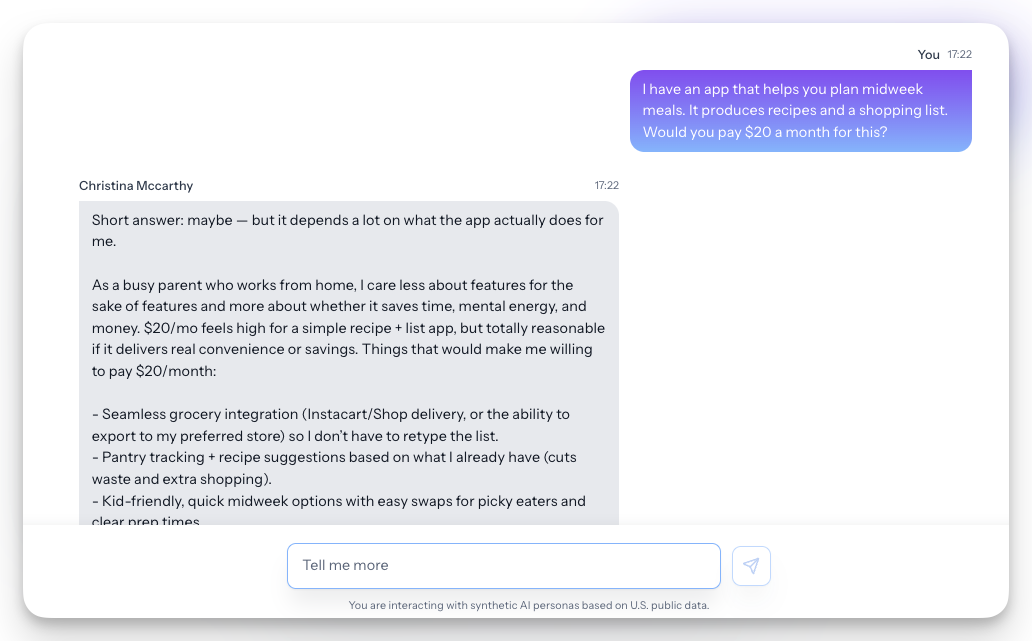
Testing Pricing Scenarios with Synthetic Personas
Once personas are established, pricing scenarios can be tested systematically.
Teams can simulate responses to:
-
Different base prices
-
Tiered or usage-based pricing
-
Feature gating and add-on pricing
-
Discounting strategies
For each scenario, synthetic personas can surface likely outcomes such as adoption rates, revenue distribution, and sensitivity to price changes.
This approach helps identify misalignments early. For example, a price that appears optimal in aggregate may disproportionately exclude lower-income but high-usage segments. Synthetic personas make those trade-offs visible before real customers are affected.
Validation Through Controlled Market Testing
Synthetic testing does not replace real-world validation, but it improves it.
By narrowing the range of plausible pricing options, teams can design more focused experiments, such as:
-
Segment-specific pricing pilots
-
Limited geographic rollouts
-
Controlled A/B tests
Observed outcomes can then be compared against persona-based predictions. Over time, this feedback loop improves both pricing accuracy and persona fidelity.
Avoiding Common Pitfalls
Organizations often misapply pricing research in several ways:
-
Treating willingness to pay as static rather than contextual
-
Ignoring income constraints in favor of stated preferences
-
Over-indexing on averages instead of segment distributions
-
Assuming survey results translate directly to purchasing behavior
Synthetic personas help mitigate these risks by embedding economic reality into the analysis.
Why This Approach Scales
Traditional pricing research becomes costly and slow as markets grow more complex. Synthetic personas scale efficiently because they reuse validated data and allow repeated testing without repeatedly recruiting respondents.
They also enable cross-functional alignment. Product, marketing, finance, and strategy teams can evaluate the same pricing scenarios using a shared framework grounded in data.
Conclusion
Accurately testing willingness to pay requires more than asking customers what they think. It requires understanding what different groups can afford and how they behave when faced with real trade-offs.
By combining public income data, established pricing research methods, and synthetic personas, organizations can move from speculative pricing to evidence-based strategy. This approach clarifies where prices create value, where they create friction, and how different segments respond under realistic conditions.
For teams looking to apply these principles using data-driven synthetic personas grounded in real demographic and income distributions, learn more about how Cambium AI can support this work.

.png)
.png)
.png)