Key takeaways
- The Decennial Census is the official population count, while the American Community Survey describes characteristics such as education, income and housing costs.
- Never compare overlapping ACS 5-year periods, such as 2005-2009 and 2006-2010, which share 80% of their data. Never compare 2020 ACS 1-year data with any other year.
- Because the ACS is a sample survey, every estimate has a margin of error, and uncertainty grows in small areas such as block groups of 600 to 3,000 people.
Whether you are an entrepreneur determining the optimal site for a new distribution center or a community leader drafting a proposal for federal infrastructure grants, your strategy is likely powered by two invisible engines: the Decennial Census and the American Community Survey (ACS).
These datasets represent the "ground truth" of the American landscape. However, while we often speak of "the numbers" as absolute, they are governed by technical nuances that can make or break a data-driven strategy. For the senior strategist, understanding these counterintuitive rules is the difference between a high-confidence projection and a costly miscalculation.
1. It’s Not About the Count, It’s About the Character
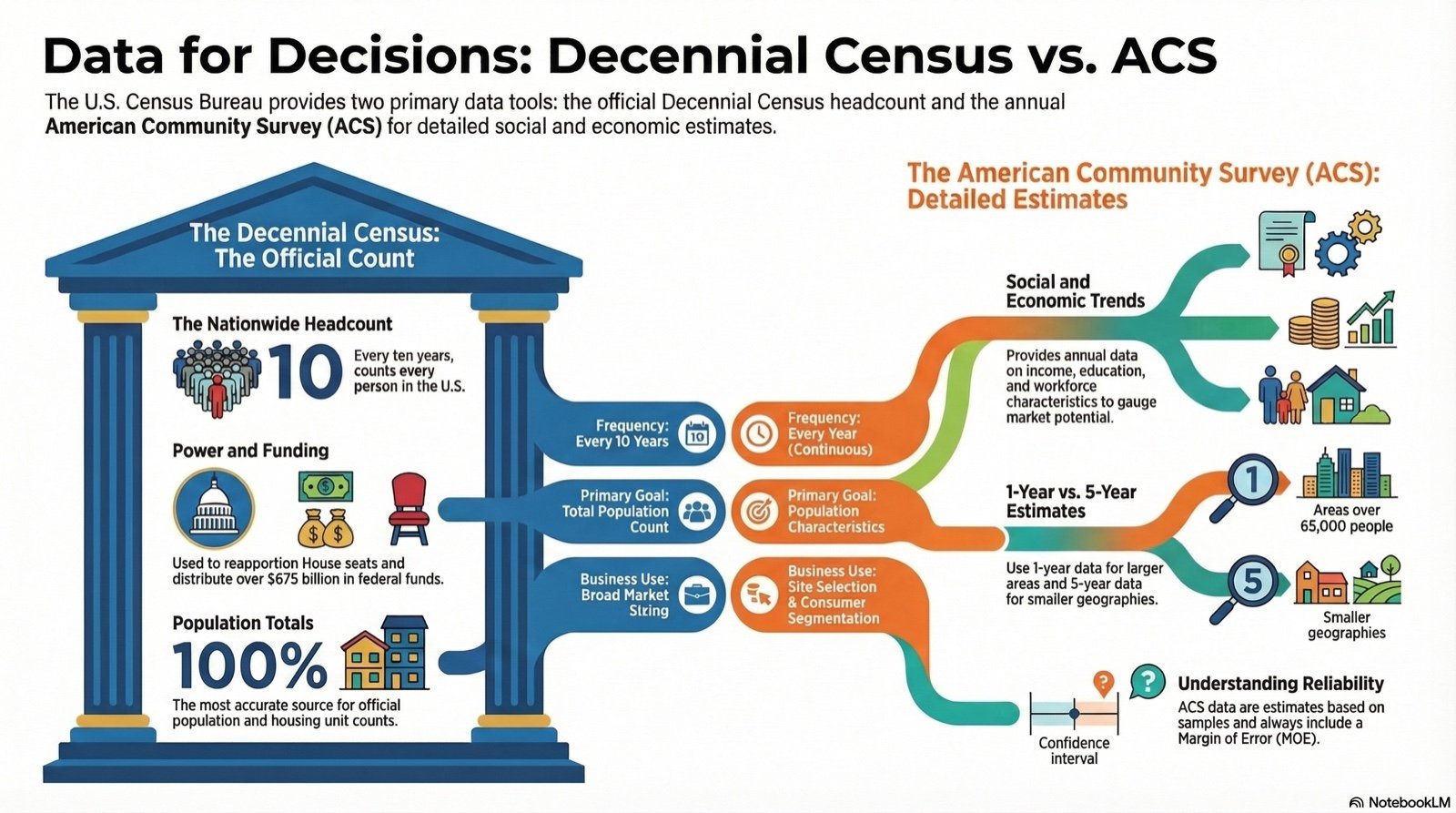
A fundamental error in geospatial market analysis is treating the ACS and the Decennial Census as interchangeable. They are distinct instruments with different objectives. The Decennial Census is a snapshot intended to provide an official count (headcount) of the population. Conversely, the ACS is a moving window designed to describe "characteristic distributions"—the social, economic, and housing "who" and "how" of a community.
While the Decennial Census provides the population base, the ACS explains the lifeblood of that population: their education, their income, and their housing costs. As the Census Bureau explicitly warns:
"The strength of the American Community Survey (ACS) is in estimating characteristic distributions. If you are looking for population totals, we recommend the 2020 Census or Population Estimates Program."
For practitioners needing data between census cycles, the Population Estimates Program provides the official annual counts for nations, states, and counties, while the ACS should be reserved for understanding the underlying demographics.
2. The "Overlap Trap" in Multiyear Comparisons
Tracking community growth or decline requires comparing datasets over time, but this process is fraught with "statistical quicksand." The ACS provides 1-year estimates (for areas with 65,000+ residents) and 5-year estimates (for smaller geographies). There are also "1-year Supplemental Estimates" designed as simplified tables for mid-sized communities with populations of 20,000 or more.
To maintain integrity, analysts must follow the "Golden Rules" of comparison:
- Period Consistency: Only compare 1-year estimates with other 1-year estimates, and 5-year with 5-year.
- The Overlap Prohibition: Never compare 5-year periods that share years. For instance, comparing the 2005–2009 period with the 2006–2010 period is invalid because they share 80% of the same data, masking any actual trend.
- Sequential Independence: Only compare non-overlapping datasets, such as the 2005–2009 estimates against the 2010–2014 estimates.
Violating these rules makes it impossible to determine if a change is a genuine economic shift or merely a byproduct of redundant data points.
3. Competitive Intelligence: How Businesses Leverage Local Data
Sophisticated firms move beyond raw demographics to perform high-level consumer segmentation and site selection. By synthesizing specific ACS variables, businesses can gauge the sales potential of a region before a single lease is signed.
Key business applications include:
- Geospatial Site Selection: Evaluating potential locations by analyzing specific workforce indicators like "travel time to work," "means of transportation to work," and "housing costs" to determine the accessibility and economic stability of a neighborhood.
- Advanced Consumer Segmentation: Utilizing variables such as "language spoken at home" and "family structure" to refine marketing lifestyle profiles and identify "ideal customers" within specific ZIP codes.
- Labor Force Analysis: Identifying specialized talent pools by filtering for "field of bachelor’s degree" and "educational attainment" to ensure a local workforce can support industry-specific operations.
4. The 2020 "Experimental" Asterisk
The COVID-19 pandemic significantly disrupted the "ground truth" of 2020. Because the global crisis prevented a standard survey cycle and hindered data collection, the Census Bureau took the rare step of labeling the 2020 ACS 1-year data as "experimental."
These estimates were produced using modified weighting methods to account for pandemic-related non-responses. Consequently, the Bureau has issued a strict directive: Data users should not compare 2020 ACS 1-year experimental estimates with any other data year. For the strategist, 2020 remains a statistical island that cannot be used to anchor long-term trend lines.
5. Embracing the Margin of Error
In technical data analysis, no number is "perfect." Because the ACS is a sample-based survey rather than a full count like the Decennial Census, every estimate includes a Margin of Error (MOE), representing "sampling error."
As we move into smaller geographic areas like "block groups" (which contain 600 to 3,000 people), the sample size shrinks, and the uncertainty grows. Professional strategists must be particularly cautious of third-party data providers who often "adjust" ACS estimates to match single-year population totals without disclosing the original MOE. This practice can hide significant uncertainty, leading to business decisions based on unreliable projections.
Pro Tip: As the population group gets smaller, the uncertainty gets larger. Always verify the MOE when analyzing sub-county data to ensure your findings are statistically significant.
Conclusion: The Data-Driven Future
The stakes of understanding this data extend far beyond corporate balance sheets. These figures historically drove the distribution of over $675 billion in federal funding (as seen in Fiscal Year 2015) for vital services like Medicaid and highway construction. Furthermore, the decennial counts dictate the very balance of political power through the apportionment of seats in the U.S. House of Representatives.
As we move forward, the narrative of communities continues to be written in these datasets. Discover the data using natural language questions with Cambium AI.

.png)